Tuesday, July 6, 2010

Starbucks a la Sierra Leone...

Or, Breakfast on the Road:
This is a photo of my go-to breakfast spot in Bo. Finding places to eat in Sierra Leone is always a challenge, and in the provinces it's only more difficult. My experience in Bo was a bit of a Goldilocks effort. The first day we drove around town and stopped at over three places looking for tea and bread, the local breakfast staples. Finally, we ended up at a mid-market 'restaurant' which served machine bread (a white bread akin to a giant hot dog bun in appearance, texture, and taste) with mayonnaise, ketchup, a boiled egg, and spaghetti noodles. The whole concept of a noodle-ketchup-and-mayonnaise sandwich was more satisying than the food itself. The tea is reliably, a half teaspoon of cocoa mix laden with a quarter cup of sweetened condensed milk and mixed with hot water. The next day we found this place. A bit more downscale and just right. For about 75 cents you get tea and Fullah bread with mayonnaise and egg. I'll have to do a bread post to introduce the various kinds available in Sierra Leone, but fullah is my second favorite, and the most widely available. It has a chewy but thin crust and soft, airy interior. Not nearly so heavy as J-wan bread and not as bland as machine bread. It took all of one hungry morning to get used to the idea of havng a mayonnaise laden loaf for breakfast. As an infrequent bread eater and someone who has never bought mayonnaise in my life, I never thought it could taste so good, especially in the morning, but I am a convert. When in Rome, and hungry...eat as the Romans do. Plus, the egg and mayonnaise, inferior ingredients as they may be, carry me through to the unreliable second meal, sourced sometime between three and six o'clock. The final Goldilocks moment was breaking ranks and telling them how to prepare my tea: No de put borku milk na me yone, yehri? Ok, ihdo. And put tealeaf, yah? With one third the sweet milk and a tea bag added, it almost tasted like something with caffeine in it.
Now that I'm back in Freetown I miss the ritual hunt for a place with thermoses lined up and mismatched plastic mugs dotting a wooden plank table. I even bought a jar of mayonnaise. But it just doesn't taste the same.

Sunday, July 4, 2010

Context for Naomi Campbell


An excerpt from the Prosecution's first expert witness to testify in the Charles Taylor trial, January 2008:

"Q. You have studied and written about diamonds' role in
conflict. Can you tell us is there anything about the
characteristics of diamonds that gives them a role in conflicts?


A. Well, diamonds are the most concentrated form of wealth on earth.
You could put five million dollars' worth of diamonds in
your pocket and it wouldn't show. It wouldn't show up on a metal
detector going through airport security. It would show up an on
an x-ray machine, but very few airports have x-ray machines. So
they are very small, they are high value, they are easy to move,
they hold their price, historically they have held their price
very well, and so they have become - not so much today, but in
the 1990s, the period that were talking about, they were an
alternative to hard currency in countries where there was no hard
currency, or where people wanted to hide the movement of money."

Available at http://www.sc-sl.org/LinkClick.aspx?fileticket=sSJXuExCeYM=&tabid=160

Oh, to be beautiful and unscrupulous.


Or, The Naomi Campbell Post:


The Special Court for Sierra Leone is still deep in calling the Defense witnesses in former Liberian warlord/president Charles Taylor's war crimes trial, but the Prosecution has recently stolen the show by subpoenaing an unlikely witness. Supermodel par excellence Naomi Campbell has been ordered by international law to cooperate with and provide testimony for the Prosecution regarding allegations that Taylor gave her a 'huge' uncut blood diamond at Nelson Mandela's residence in South Africa (!) in 1997. It is a totally bizarre scenario with actress Mia Farrow also set to testify as a witness to the transaction. The relevance to the trial is seemingly tangential, but if Campbell's testimony affirms that Taylor gave her the rough diamond it would prove that Taylor's claims to have never possessed uncut diamonds were lies. Stay tuned, and reevaluate your opinion about paparazzi-punching Naomi Campbell as you will. I personally wish she had used her elite status as a mainstream supermodel to uplift and empower black women the world over rather than profiteer off African suffering, but indeed, the jury is still out.

Things I Learn in Sierra Leone


One of the great triumphs of Sierra Leone is people's fearless resourcefulness. Nothing, it seems, is ever broken beyond repair. (But, before we get distracted by silver linings, I want to underscore that this is all a consequence of poverty, deprivation, and global marginalisation. From a tree-hugging perspective it seems great that someone in Sierra Leone can almost always put another's cast-off to use, and that everything is salvageable, revitalizable, fixable. In reality, everyone would rather have nice new things.) That said, I have learned so much about how to do more with less here it is a constant source of excitement.

First of all, cars generally arrive after a decade or more of previous Western use and with hundreds of thousands of miles already on them. As a result, I have learned a LOT about cars. It's hard to know much of anything about cars in America because they don't break down very much, when they do it's usually due to some remote controlled electrical computerised robot failure, and to be fixed they are carted off on tow trucks into magic secret jiffy stations that give them hundred-dollars cures behind the scenes. In Sierra Leone, however, cars are actually machines with working -or not, as the case may be- parts that can be de- and re-constructed countless times.

I have learned how to push start (method of choice) dead battery cars, as well as use a truck's ill fitting battery to juice a car, then change the battery while keeping the engine running to load the correct-but-dead battery. Both of these methods, incidentally, have rescued the barbie safari car.

Also, did you know that cars can run without a key in the ignition? A wildly entertaining taxi ride featured a driver whose key kept falling out of the ignition and landing on the floor at his feet. Over and over again. I couldn't stop laughing.

Fueling cars is an artform in itself. While there are some brand new foreign-owned filling stations in Freetown, the breadth of fueling activities across the country is like a history lesson in gas stations. The first revelation was watching young boys hand crank the fuel up into the one gallon jug at a National Petroleum (NP) station on the Freetown-Makeni highway before the fuel - "petrol" - was delivered by hose and nozzle to my car. Even more striking was the handmade gallon jug with funnel attachment I posted a picture of a few weeks ago (see below, June 14th-ish). Sure, it's obvious that you can just pour petrol into a car, I guess, but who would ever try that at home?

Everything in America has become so highly technical, that it has been sterilized and specialised. I would have never dreamt nor dared to hand-fuel a car. But being in Sierra Leone brings me a little closer to the form-function nexus. And is not only educational (nay I say revelatory) but also a bit liberating. Things aren't so fancy, and unfortunately sometimes they do not work so well for lack of supplies, but where there is a problem, people tend to be much more closely connected to the solution than in the States.

This brings me to the breakdown while driving to Tongo Field. As I explained in the previous post, a large rock buried in the mud cut my exhaust pipe between the first and second chamber, making my car growl like a Harley (so annoying and intrusive passing villages!) and making it, as my colleague and assistant described, "lazy," or slow. With no option but to keep on trucking, we roared our way slowly (a hilarious combination) to the impoverished diamond mining town. Enter the garage. The men there were working furiously on an engine-less car that has clearly not been driven anywhere in recent memory, but happily pushed it aside (literally) to take a look at my own exhaust problem and weld the pipe back together.


The old man knew cars. He wanted to check all my various oils and fluids and greases, and lauded the car as a "strong car" - it's persistent accolade amongst locals. I have had many parts welded back together on this once rust-afflicted vehicle, so am no longer as dazzled by the straightforwardness of melting metal with metal to repair damage. What was new this time was the ditch they'd built beneath the tire tracks to more easily see and reach around under the chassis. I've always pitied mechanics here because they seem to routinely have to dive under cars on their backs and bellies, lacking those hydraulic sky jacks that perilously hoist cars to the rafters in American garages. Yet, in Tongo they had created the most poetically logical solution I could imagine, simply walking beneath the car to work from below. Yes, the welder still worked without eye protection, and the lack of spare parts was total...but the human capital was boundless. They let me squeeze in under the car with them to examine the problem in my bright pink dress, patiently showed me a few other places I might want to check out in Freetown, and brought a chair out of nowhere to make sure I sat down while they worked. And the price? Le 35,000, about $9. I'm grateful for the opportunities I have had here to learn more about cars and how to fix things in general.

Add to the list of lessons learned: drive in pants and wear brown so that breakdowns aren't such a mess. I immediately employed this lesson on the drive to Kailahun, and immediately benefited when the car 'fashuned' (fastened/got stuck) in the 'pohto-pohto' (mud) for over an hour.

Add to the list of lessons learned: always inquire if a road is passable before trying to drive it, and How to Pull a Car out of Several Feet of Mud when the Four-Wheel Drive Fails.

Friday, July 2, 2010

Introducing...The African Barbie Safari Car!

This is my car and it is amazing. When I first saw it, I thought it was too embarassing to even consider owning without spraying over the 1990's Barbie-colored Danish graphics, and now I love it like nothing else. It is an extension of me and makes me feel particularly accomplished (quite a feat for what is effectively a luxury item in this country). Why does it make me feel like a champion?

1. Manual transmission
I learned to drive stick shift on safari in South Africa, but really, driving on open roads, dodging only rhinos is a lot easier than driving through the pot-hole ridden, stone strewn, heavily populated, narrowly constructed streets of Freetown. I like to think I really learned to drive stick in Sierra Leone, a place where even experts might reconsider driving a car.

2. The bad, bad roads
Nothing warrants a victory cheer like overcoming a road made of [boulders, holes, mud, water, etc.]

Effectively 'off'-roading + stick shift = road warrior. My greatest accomplishment yet, sad to say.


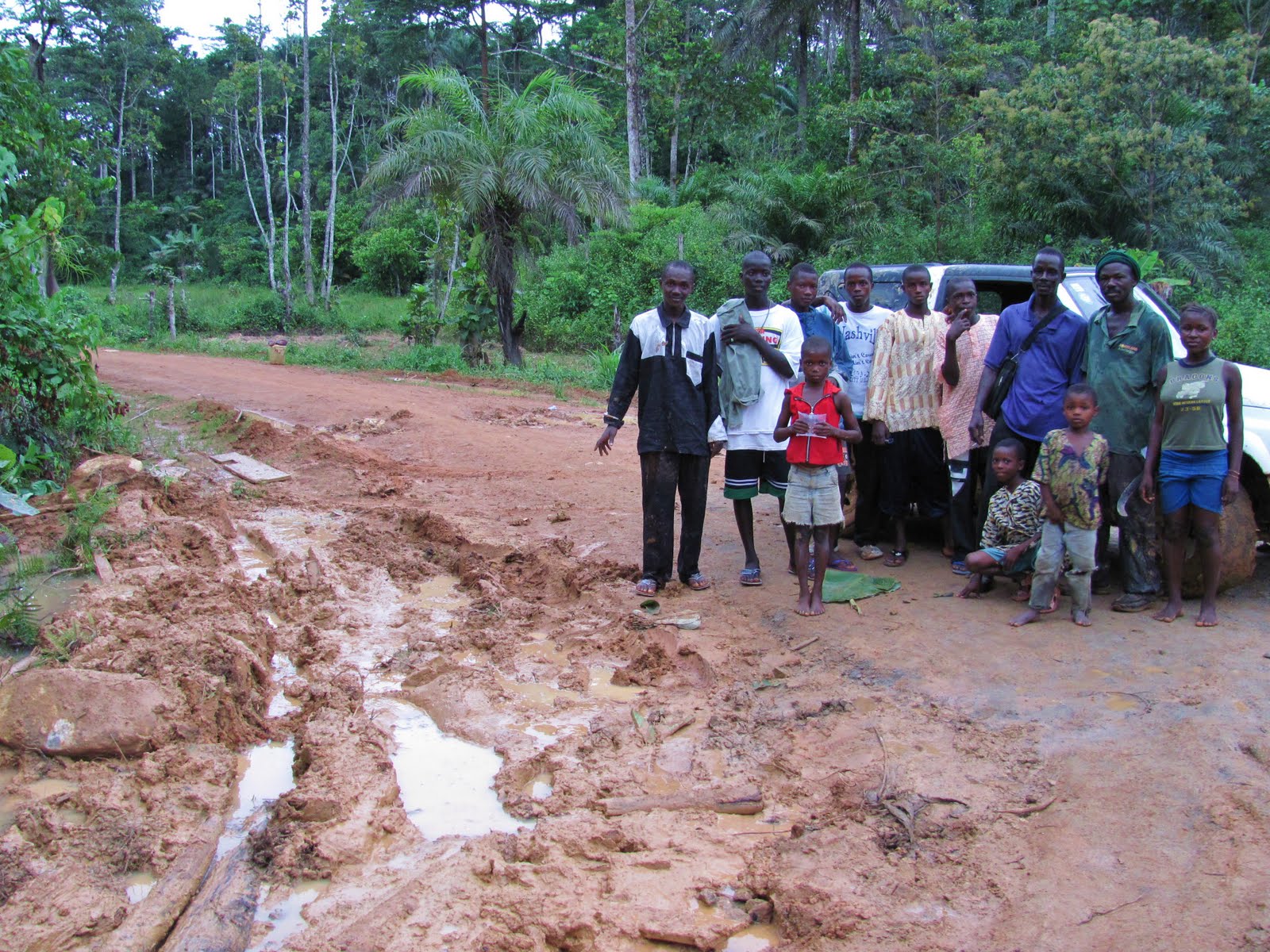
See the mud? This is the road to Tongo Field, a diamond mining area. An infamously bad road, we took it 'small small' (cautiously). This road led me to mentally categorize roads by which gear I spend most time in. Tongo was a 1/2 road. Not good. On the upside, I learned How to Drive through Mudholes:
Go straight through the middle - bypasses will tend to make you slide out, and other cars must also ply the road, therefore the problem has *probably* been fixed with rocks beneath all the mud; stay in a low gear; move slowly; don't turn the wheel; and definitely don't stop.
This did not save my exhaust pipe, which cut on the way going. Padding the mud with enormous rocks is marginally unhelpful, although I appreciate some concerned citizen's effort to keep cars from getting stuck in the mud. Not seeing the stone, and having a little too much zeal-at-the-wheel, I bottomed out mid-mud and the corroded exhaust pipe unceremoniously cut. Next post will feature this episode along with other: Things I learn in Sierra Leone.

Road Trip, part two

It's been many weeks since my last post due to a drought in the internet supply and another road trip in the provinces. I returned to Freetown this week after finally (yes!) making it to the Southern and Eastern Provinces and their attendant, headlining highway towns. My first stop was Bo - the "second city", or LA to Freetown's New York, although the size makes it a bit more like, oh I don't know, Bellingham before it had suburbs and sprawl? Driving on the brand spanking new road from Masiaka to Bo was glorious in itself, and were it not so conducive to driving smoothly and efficiently without braking I would have stopped to take a few pictures. Until my next trip, a description will have to suffice.

The highway is a real two-lane work of art. Sparkling black tar. Banked on all the right curves. Lined, striped and dotted with bold yellow and white paint. Occassional road signs - new and relevant to boot - warn of sharp bends. And the coup de grace to ensure the fine work doesn't wash out in one rainy season, steep gutters and embankments for run-off. The drawback to this drainage solution is that there is not much in the way of a shoulder. In fact, there's none but two feet or so the whole length of the highway. This seems to be a problem afflicting the entire country and is in my inexpert opinion the number one culprit for the heavy number of road fatalities. (The runner-up would be bad-plus-overzealous drivers.) Without a shoulder to pull onto and with all major arteries in the country two-narrow lanes at best, trucks, lorries, passenger vehicles, tractors, etc. all break down in the middle of the road and generally only on curves and hills, where visibility is worst.

Dear Government of Sierra Leone,
Please consider adding a (hard or soft) shoulder to your existing road construction projects: So that vehicles can break down where God wills them to, and not just in the village pull-outs (where He inevitably does not will them to). So that vehicles can swerve to safety when death defying maniacs overtake into oncoming traffic, rather than having to plunge into steep gullies, gutters, swamps, and forested ditches. So that when people repair breakdowns, they don't need to leave clods of dirt-and-grass strewn along the newly smoothed road to act as flares.
Faithfully yours,
Cautious driver

I suppose the upside is that, without much in the way of a towing service, the skeletons of broken cars along the side of the road act as a macabre reminder of road safety and deterrent to speeding. Although, sadly, I'm not sure the speeding drivers of the luxury SUVs and 'road giants' (Toyota LandCruisers, driven by NGOs and NGO-funded government ministries and which make up roughly 40% of the vehicles on the roads in Sierra Leone, inching toward 100% in distant Kailahun District) are driving slowly enough to see them.

After my solo cruise, powered by the fine road and some fine tunes, terminated in Bo, I commenced a few days of networking and interviewing, then moved on to Kenema. From Kenema I made an epic day trip to Tongo Field, and an epic over-night trip to Kailahun, before returning back to Kenema, back to Bo, and once again to Freetown. I will try to post a few photos here and there, though it's not too encouraging that my first post on my previous road trip was also the last one. It appears we have a much-predicted backlog.

Lots of love.
xoxo

Tuesday, June 15, 2010

Road Trip, part one.

I just returned to Freetown yesterday from one week in the Northern Province. I started in Magburaka, where I helped a friend's local NGO hold a HIV/AIDS "peer animator" training workshop. I was mostly there for show - in Sierra Leone white faces are often seen to add gravitas to any development type effort - but led a few of the facilitations. It brought back many memories of leading various trainings throughout high school and college, and made me appreciate all over again the joys of sexual health education and the empowerment it gives people over their own bodies and personal lives. The condom distribution was a big hit; most of the 30 odd participants came into the district capital, Magburaka, from more rural towns and villages where condoms aren't readily available. One 'Pa' (the only older man in the workshop) took an entire box that he was happy to carry back to his community. All of the participants knew quite a bit about HIV/AIDS and other STIs, and had clearly been trained before, but still had gaps in their knowledge. It was heartening to see their active engagement and ready acceptance of the benefits and drawbacks of condom use. However, it was a somber reminder of the limits of education to realize that the tools (in this case condoms, but c.f. bednets, vaccines, early treatment of health problems, etc.) are not necessarily available in people's communities...